

Event managers – the method to the madness
Many moons ago, when we first started dipping our toes into the event industry, we knew very little about it. In fact, we only realized how little we knew much later.
Some of us were developers. Some were designers. And yours truly was buried deep in the technical side of events: the person who knows what every knob does, which cable goes where, and why that one connector always disappears five minutes before the doors open.
We had heard about those mythical creatures called event managers, of course. But even when we occasionally crossed paths with them, we tended to keep our distance. They always seemed impossibly busy, slightly grumpy, and permanently surrounded by people asking questions.
At the time, we assumed this was simply part of the job description.
After more than a decade working alongside them, however, we’ve come to realize something important.
There is, in fact, a method to their madness.
A definition
We’ve stumbled across this definition many times:
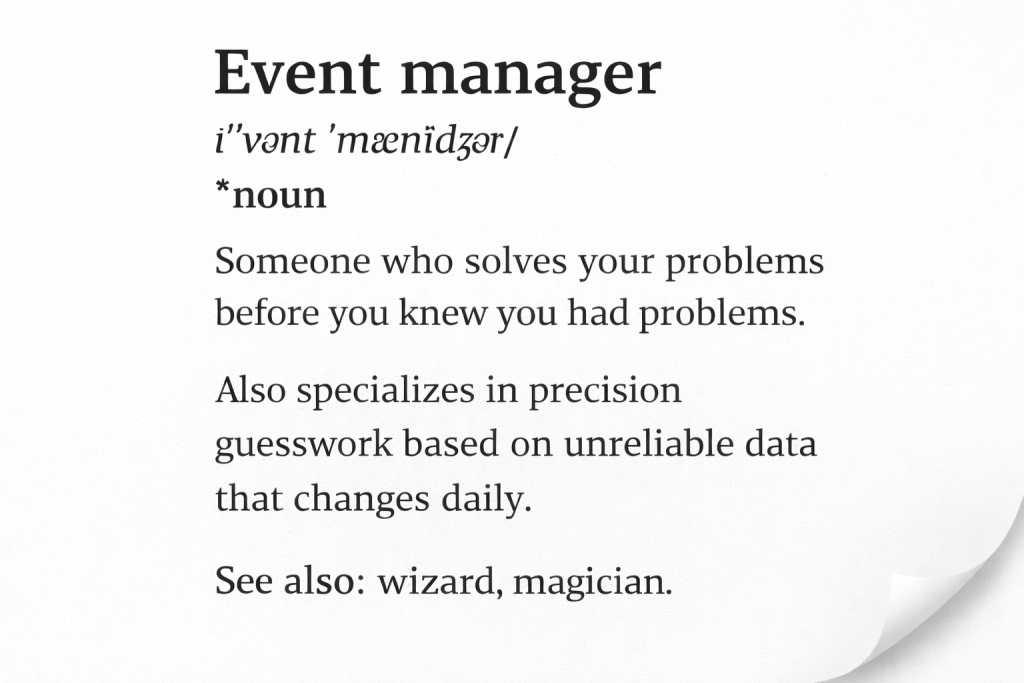
It might seem like a humorous definition of an event manager, and it may make you chuckle or even laugh out loud. But it’s actually surprisingly accurate and it explains a lot.
Seems simple, feels complicated
From the outside, managing an event can look deceptively straightforward. You pick a venue, sell some event tickets, promote the program, and open the doors.
From the inside, however, the entire process feels more like assembling a complex LEGO set where half the parts keep changing shape and the other half you keep losing over and over while you’re working.
Attendance estimates shift daily, speakers cancel unexpectedly, equipment fails at the worst possible moment, weather forecasts change their mind every six hours. And someone always discovers a logistical problem roughly ten minutes before it becomes visible to the public.
This is what actually the real job of an event manager looks like.
And the public rarely sees the hundreds of small decisions that happen behind the scenes. They don’t see the backup plans, the last-minute adjustments, or the constant quiet adjustments for timing, capacity, and resources.
What attendees experience as a smooth evening is usually the result of dozens of potential problems being solved before anyone else even realizes they existed.
Precision guesswork
The second part of that definition might be even more relatable to anyone who has worked in the industry.
"Precision guesswork based on unreliable data that changes daily."
Every event involves planning, forecasting, and making decisions based on information that is, at best, incomplete. Event managers spend weeks or months making educated guesses about things that will only reveal their true shape when the event finally begins.
And when the event starts, it's not the end of the struggle. Oh no, not at all. Adjustments continue and seemingly never stop.

Job description
Event managers often joke (or are they serious?) that their job description includes parts strategist, parts problem-solver, and parts magician.
Watching them work, it’s easy to understand why. It also explains why their mental state can often appear a bit… volatile.
- A microphone stops working? Somehow another appears.
- A queue forms where nobody expected one? The check-in flow is quietly redirected.
- A schedule slips? Adjustments happen without the audience ever realizing the original plan changed.
To attendees, these things often feel invisible.
To event managers, they are simply another Tuesday.
Or Friday.
Or any other day when hundreds of moving parts have to behave long enough for the event to feel seamless.
Picture this
There’s a festival happening over several days with about a dozen stages.
Naturally, each stage has its own stage manager. Their job is to keep the schedule intact, keep the artists happy, monitor the mood of the crowd, and quietly assess whether additional security might be needed. In other words, each stage has its own event manager responsible for making sure everything runs smoothly.
And then the headliner is about to go on.
The artist most people bought tickets for. The reason thousands of people are standing in front of that stage.
The stage manager walks backstage about fifteen minutes before the show to make sure everything is ready.
And then it happens...
The artist suddenly demands fresh bananas before going on stage.
The stage manager calmly points to the table filled with fruit, including a perfectly respectable pile of bananas.
But no. Those bananas are apparently unacceptable. They insist on fresh bananas or they won’t perform.

You have fifteen minutes.
It’s 11 PM.
Negotiation is clearly not an option.
So what do you do?
Call other stages on the radio asking for emergency banana assistance? Probably not. Instead, the stage manager grabs the nearest unfortunate volunteer, sends them into a car, and dispatches them on a late-night banana rescue mission to the nearest shop that might still be open.
Miraculously, the bananas are found. The show starts fifteen minutes late.
The headliner takes a single bite of one banana and casually remarks: “I just wanted to see how badly you wanted me here.”
It’s only one story among thousands. But it perfectly illustrates the strange, unpredictable situations event managers find themselves solving on a regular basis. Because behind every smooth event there are dozens of small crises that never make it into the audience’s experience.
And yes, sometimes those crises involve bananas.
Are you one of them?
If you’ve ever managed an event, chances are this description feels painfully familiar. And we feel you. Our condolences.
If you have a story you want to get off of your chest that proves this wrong (or more likely, proves it even more accurate), we’d love to hear it.
What’s the strangest, most stressful, or unexpectedly hilarious situation you’ve had to solve while running an event? Chances are someone else in the industry has experienced something very similar.