Quick answer
To prevent ticket scalping, make each ticket verifiable and hard to resell anonymously: issue unique QR-coded tickets that die after one scan, put the buyer’s name on the ticket and spot-check IDs, cap the number of tickets per order, and give genuine attendees an official way to transfer tickets they can’t use. Scalpers profit from anonymity and scarcity — remove both and the resale market around your event dries up.
- Unique, one-scan QR codes make duplicated or screenshotted tickets worthless at the door.
- Purchase limits and named tickets stop bulk buying before it starts.
- An official transfer path gives honest attendees an alternative, so the gray market never gets its inventory.
In this guide
- Why scalpers target events like yours
- How ticket scalping actually works
- Pricing and release tactics that starve resellers
- Purchase limits and buyer verification
- Named tickets and ID checks
- Unique QR codes and one-scan validation
- Offer an official transfer path
- Publish and enforce a clear resale policy
- How Tickera helps you keep tickets in the right hands
- Anti-scalping checklist
- FAQ
Why scalpers target events like yours
Most organizers assume scalping only happens to stadium tours and championship finals. In reality, resellers look for one simple condition: demand that outstrips supply, even briefly. A 300-seat theater show that sells out in a week, a local food festival with a capped VIP tier, a conference with a limited early-bird allocation — all of these produce the price gap a reseller needs.
The damage goes beyond the markup. Attendees who overpay on a resale site blame you when something goes wrong. Duplicated tickets create disputes at the door and slow down your entry line. And every ticket that changes hands anonymously is an attendee you know nothing about — no email address, no dietary info, no way to notify them of a schedule change. If you’ve invested in a solid check-in strategy, uncontrolled resale is the thing most likely to undermine it.
How ticket scalping actually works
Understanding the mechanics makes the countermeasures obvious. Resellers typically use one or more of these plays:
Bulk buying. One buyer (or one person with several cards and email addresses) grabs ten, twenty, or fifty tickets the moment sales open, then lists them at a markup once the event sells out.
Speculative listing. The reseller lists tickets they don’t own yet on a secondary marketplace, waits for a buyer, and only then purchases from you — pocketing the difference. Your event’s name and imagery are used to sell something you never authorized.
Duplication. A single legitimate ticket is sold as a PDF or screenshot to multiple buyers. Everyone holds a “valid” barcode; only the first one scanned gets in. The rest become angry refund demands at your door.
| Scalper tactic | What it exploits | Your countermeasure |
|---|---|---|
| Bulk buying at on-sale | No per-order limits | Cap tickets per order; stagger releases |
| Speculative listings | Anonymous, transferable tickets | Named tickets + published resale policy |
| Duplicated PDFs | Static, reusable barcodes | Unique QR codes voided after one scan |
| Last-minute markup sales | No official transfer option | Official transfer or ticket-release path |
Pricing and release tactics that starve resellers
Scalping is arbitrage: the reseller profits from the gap between your price and what the market will pay. You can shrink that gap with the same tools you already use to sell tickets.
Release inventory in waves rather than all at once. When a second wave is announced in advance, buyers who miss the first release wait for the next one instead of panic-buying from a reseller. Tiered pricing helps too — if your ticket pricing strategy already steps prices upward as the event approaches, the “face value” a scalper bought at early-bird is quickly matched by your own current price, killing their margin.
Keep a small reserve of tickets for release in the final week. Publicize it. Nothing deflates a secondary market like the knowledge that official tickets will be available closer to the date.
Purchase limits and buyer verification
The cheapest anti-scalping measure is a hard cap on tickets per order. For most events, four to six general admission tickets per purchase covers legitimate families and friend groups while making bulk acquisition tedious. For high-demand VIP tiers, consider a limit of two.
Pair the cap with light verification. Requiring a real email address per order — and sending tickets there rather than displaying them on-screen — adds friction for someone juggling twenty fake identities while costing genuine buyers nothing. Custom checkout fields can also ask for each attendee’s name at purchase time, which sets up the next measure.
Be careful not to overdo it: every extra checkout field costs you some conversion. Apply the strictest rules only to the ticket types that scalpers actually want, and keep the path for ordinary buyers as smooth as the one described in our guide on how to sell more event tickets.
Named tickets and ID checks
A ticket that carries the attendee’s printed name is dramatically harder to resell anonymously. The buyer on a secondary marketplace knows the name won’t match their ID, so the listing itself becomes less attractive — often you never have to check a single ID for the deterrent to work.
If you do verify, spot-checking is usually enough. Checking every ID at a 2,000-person event will wreck your entry flow; checking one attendee in ten (or only VIP and front-row holders) preserves the deterrent at a fraction of the cost. Decide in advance what happens on a mismatch: a polite redirect to a resolution desk keeps the main line moving and keeps confrontations away from the gate.
The goal of named tickets isn’t to catch resold tickets at the door — it’s to make resale listings unattractive enough that the tickets never leave the original buyer’s hands.
Unique QR codes and one-scan validation
Duplication — one ticket sold to many buyers — is the scalping variant that hurts attendees most, and it’s the one you can eliminate completely. The fix is a unique code per ticket, validated live at the door and voided after its first scan. The second person presenting the same code is flagged instantly, before they’re inside.
This only works if your check-in tooling validates against a live database rather than just reading the barcode visually. Our event ticket QR code guide covers the mechanics in depth, but the operational rules are simple:
| Practice | Why it matters |
|---|---|
| One unique code per ticket, never reused | Makes shared screenshots worthless after first entry |
| Live validation at scan time | Duplicates are caught at the gate, not discovered later |
| Instant void after check-in | Closes the window for a code to be used twice |
| Scan log with timestamps | Resolves “but I bought this ticket” disputes with evidence |
The scan log matters more than most organizers expect. When two people hold the same code, the timestamped record of who scanned first — and which order the ticket belongs to — turns a shouting match into a two-minute resolution.
Offer an official transfer path
Here’s the counterintuitive part: the best way to control resale is to allow it — on your terms. Most tickets on the gray market aren’t sold by professional scalpers; they’re sold by ordinary buyers whose plans changed. If their only options are eating the cost or listing on a marketplace, many choose the marketplace, and that listing sits right next to the scalper’s inventory, legitimizing it.
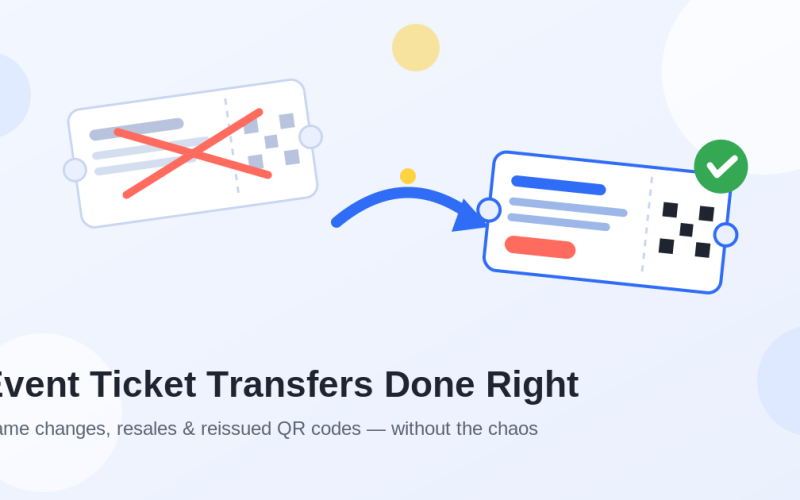
An official transfer mechanism reroutes that inventory. The original buyer reassigns the ticket to a new attendee; the old QR code is voided and a fresh one is issued in the new attendee’s name. You keep accurate attendee data, the new holder gets a ticket that’s guaranteed valid, and the secondary marketplace loses its supply. Tickera’s ticket transfer feature handles exactly this flow.
Pair transfers with a sensible refund policy. A buyer who knows they can get a credit or transfer their ticket has no reason to gamble on a resale site — our refund policy playbook walks through the options.
Publish and enforce a clear resale policy
Deterrence needs to be visible. State your policy in three places: the ticket purchase page, the confirmation email, and the ticket itself. Keep it short — for example: “Tickets are personal, non-transferable except via our official transfer tool, and unique per attendee. Tickets bought from unauthorized resellers may be refused entry.”
Then enforce it consistently but humanely. The person standing at your gate with a resold ticket is usually a victim, not a perpetrator. A resolution desk that offers them the chance to buy a valid ticket on the spot (if capacity allows) converts a bad moment into recovered revenue, while the timestamped scan log gives your staff the facts they need.
How Tickera helps you keep tickets in the right hands
Everything above is built into Tickera, the ticketing system that runs on your own WordPress site. Every ticket carries a unique QR code generated at purchase. The Checkinera app validates codes live and voids them on first scan, with a complete timestamped check-in log for dispute resolution. Custom forms let you collect attendee names at checkout and print them on the ticket, and per-order quantity limits rein in bulk buying. When plans change, the ticket transfer flow reissues a fresh code to the new attendee and kills the old one automatically.
Because Tickera is self-hosted with no per-ticket fees, you also control the sales data end to end — no third-party marketplace sitting between you and your attendees. See Tickera pricing for the current license options.
Anti-scalping checklist
- Set a per-order ticket limit (4–6 GA, 2 for premium tiers).
- Collect attendee names at checkout and print them on tickets.
- Use unique QR codes with live validation and one-scan voiding.
- Announce staged releases and hold back a final-week allocation.
- Enable an official transfer path and publicize it in confirmation emails.
- Publish a short resale policy on the sales page, email, and ticket.
- Plan a resolution desk and spot-check ID procedure for event day.
- Keep the check-in scan log accessible to door staff for disputes.
Final thoughts
You can’t sue the secondary market out of existence, but you don’t need to. Scalping is a business, and businesses die when their margins do. Purchase limits shrink the supply a reseller can acquire, named tickets and one-scan QR codes shrink what a buyer will pay for an unofficial ticket, and an official transfer path removes the honest inventory that keeps gray markets liquid. Put those four in place before your next on-sale and the problem largely solves itself — quietly, before anyone ever reaches your gate.
FAQ
Is ticket scalping illegal?
It depends on where your event takes place. Some countries and US states ban resale above face value or require reseller licenses, while others allow it freely. Regardless of local law, you can set your own terms of sale — making tickets personal and non-transferable outside your official channel is a contractual condition you’re entitled to enforce at the door.
Do purchase limits hurt legitimate group bookings?
Rarely, if you plan for them. Keep a separate group-booking channel — a form or email contact where genuine groups can request larger allocations — and apply the automated cap only to standard online checkout. Bulk buyers avoid channels that require a human conversation.
Will checking IDs at the door slow down entry?
Full ID checks will; spot checks won’t. Verifying roughly one attendee in ten, or only premium ticket holders, preserves most of the deterrent effect with minimal impact on line speed. Route any mismatch to a separate resolution desk so the main line keeps moving.
What should I do if someone arrives with a resold ticket?
Treat them as a victim first. Check the scan log to confirm whether the code is valid or already used, explain the situation, and if capacity allows, offer them a chance to buy a valid ticket on the spot. Confrontation at the gate costs you more in atmosphere and reviews than the recovered seat is worth.
Can screenshots of QR code tickets be used to sneak in?
Only once — and that’s the point. With unique codes validated live and voided at first scan, a screenshot is just a copy of the same code. Whoever scans first gets in; every subsequent attempt is flagged as already used. Static barcodes without live validation offer no such protection.
Should I ban ticket transfers completely instead?
Usually not. A total ban pushes buyers whose plans changed onto unofficial marketplaces, which is exactly where you don’t want your tickets. An official transfer tool that reissues a fresh named ticket gives them a safe alternative and keeps your attendee data accurate.