Quick answer
A good event ticket pricing strategy starts with your revenue target, then uses clear ticket tiers, early-bird deadlines, VIP upgrades, and checkout data to increase sales without training buyers to wait for discounts.
- Start with the revenue goal before setting ticket prices.
- Match ticket tiers to audience expectations and buying urgency.
- Use pricing deadlines, VIP options, and checkout data to improve sales without relying on panic discounts.
Pricing event tickets is one of the most important decisions an organizer makes. Set the price too high, and people hesitate. Set it too low, and you may sell out without making enough revenue to cover costs, grow the event, or invest in a better experience.
The hard part is that ticket pricing is not just math. It is psychology, timing, positioning, audience trust, and perceived value working together. That is why pricing should be planned before the campaign launches, not patched together after sales slow down.
If your next goal is overall growth, pair this guide with our breakdown of how to sell more event tickets in 2026. If you are selling through WordPress and WooCommerce, also read our guide on selling event tickets with WooCommerce without marketplace fees.
Why Ticket Pricing Matters More Than Most Organizers Think
Many event organizers treat pricing as a final step. They plan the venue, speakers, sponsors, schedule, production, staff, and marketing, and only then ask: “So, how much should we charge?”
That usually leads to one of two mistakes: copying competitor prices or choosing a number that simply feels reasonable. Both can work occasionally, but neither is a strategy.
A cheap ticket is not always easier to sell. Sometimes it creates doubt. A premium ticket is not always harder to sell. Sometimes it creates desire.
Your ticket price influences perceived quality, purchase urgency, early cash flow, marketing budget, and attendee expectations. The goal is not to find the lowest price people will accept. The goal is to create a structure that matches your audience, your value, and your revenue goals.
Start With Your Event Revenue Goal
Before choosing ticket prices, define your target revenue. Include venue cost, staff, speakers, equipment, marketing, payment processing fees, insurance, production, emergency buffer, and profit target.
For example, if your event costs $40,000 to produce and you want $20,000 in profit, your target revenue is $60,000. If your venue capacity is 500 people, that does not automatically mean every ticket should cost $120. Not every ticket will sell at the same price.
| Ticket type | Example price | Purpose |
| Early bird | $99 | Create early momentum and cash flow |
| General admission | $139 | Main revenue tier |
| Late ticket | $169 | Capture last-minute buyers without punishing early buyers |
| VIP ticket | $249 | Increase average order value |
| Group ticket | 5 for $595 | Encourage teams and organizations to buy together |
This is where smaller ticketing choices can quietly shape your profit. For a deeper look at margin leaks, see small ticketing decisions that quietly hurt your margins.
Understand Your Audience Before Setting the Price
A ticket price that works for one audience can fail completely with another. A $299 ticket for a B2B conference may feel affordable if attendees expect networking, leads, education, and business value. The same price for a small local hobby event may feel unrealistic unless the experience is truly premium.
Pricing questions to answer before launch
- Is this a professional, entertainment, education, community, or nonprofit event?
- Are attendees paying personally, or is their company paying?
- Is the event local, regional, national, or international?
- How urgent is the problem your event solves?
- How unique is your event compared to alternatives?
- Will attendees also pay for travel, hotels, food, or parking?
Pricing is not only about what your event costs. It is about what your audience believes the event is worth.
Use Tiered Pricing to Create Momentum
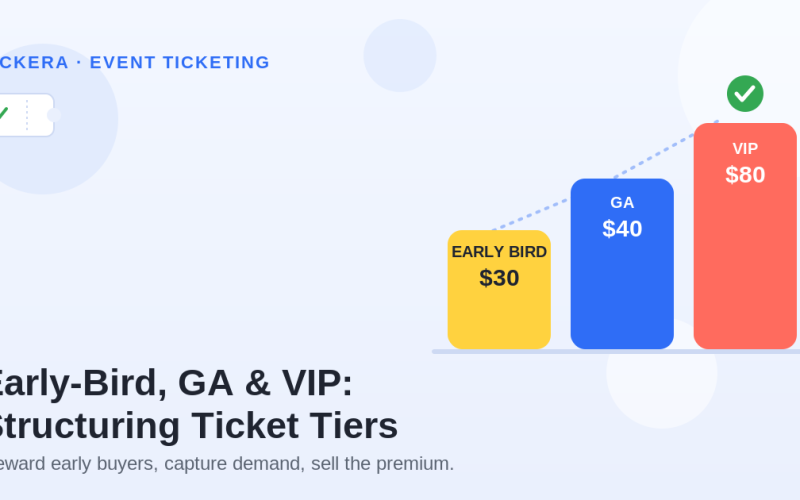
One of the most reliable ways to sell more event tickets is tiered pricing. Instead of offering one fixed price from launch to event day, you create multiple pricing stages.
| Stage | Price | Message |
| Super early bird | $79 | Best price for fastest action |
| Early bird | $99 | Reward early commitment |
| Regular | $129 | Standard campaign price |
| Late | $159 | Final deadline price |
This structure rewards people who buy early and creates urgency without relying on random discounts. The message is simple: buy earlier, pay less.
Use real deadlines and clear communication. Google’s own ecommerce guidance stresses the value of clear, accurate product information for shoppers; the same principle applies to event tickets. See Google Search Central’s product structured data documentation for how search engines interpret price, availability, and offer information.
Do Not Make Early Bird Tickets Too Cheap
Early bird tickets can help you build momentum, but they can also hurt revenue if the discount is too aggressive. If your regular ticket is $200 and your early bird ticket is $49, people may wonder whether the event is really worth $200, whether another discount is coming, or whether they should wait.
A healthy early bird discount is usually enough to motivate action without damaging perceived value. In many cases, 15–30% works better than 60–70%. The goal is to reward early commitment, not apologize for your price.
Create Ticket Types Based on Value, Not Confusion
Multiple ticket types can increase revenue, but only if each option is easy to understand. Good ticket types are based on clear differences in value.
| Ticket type | Best for | What to include |
| General admission | Standard attendees | Entry, main sessions, basic materials |
| VIP ticket | Premium buyers | Priority check-in, reserved seating, lounge access, speaker meet-and-greet |
| Group ticket | Teams and organizations | Multiple tickets, simple buyer management, team discount |
| Online access | Hybrid audiences | Livestream, recordings, digital resources |
Avoid creating too many ticket types with tiny differences. If buyers need to think too hard, they may delay the purchase. A simple pricing table with two to four clear options usually performs better than a confusing list of twelve ticket variations.
The same clarity should continue after purchase. If your door process is part of the experience, review what organizers need to know about ticket check-in at the door.
Use VIP Pricing to Increase Average Order Value
VIP tickets are not only for luxury events. They work whenever part of your audience wants a better, easier, faster, or more exclusive experience.
Instead of charging all attendees $150, you might offer general admission at $129 and a VIP ticket at $249. Some attendees only want access. Others are willing to pay more for comfort, convenience, status, or deeper access.
The key is that VIP must feel genuinely valuable. Do not charge more for a badge color and call it premium. Give VIP buyers something they can immediately understand.
Be Careful With Discounts
Discounts can increase ticket sales, but they can also train your audience to wait. If people learn that every event gets a 30% discount one week before the deadline, they will stop buying early.
Use discounts when they have a reason
- Partner promotions
- Sponsor campaigns
- Community groups
- Student access
- Nonprofit access
- Past attendee loyalty
- Limited-time launch campaigns
Avoid panic discounts, random promo codes, huge last-minute discounts, and public discounts after early buyers paid full price.
If you discount too often, your regular price stops being believable. A better approach is to create planned pricing tiers and communicate them clearly from the start.
Show Buyers What They Get
People do not buy tickets only because of the price. They buy because they understand the value. If your event page only says “Conference ticket — $149”, you are making the buyer do too much work.
Instead, show the number of sessions, speaker lineup, workshops, networking opportunities, food and drinks, recordings, certificates, community access, downloads, entertainment, business outcomes, and personal benefits.
The price did not change. The perceived value did.
For additional event visibility, make sure your event information is also structured clearly for search. Google documents event-specific fields such as date, location, name, and offers in its Event structured data guide.
Add Urgency Without Being Pushy
Urgency helps people make decisions, but fake urgency damages trust. Use real urgency based on limited ticket quantity, price increase dates, venue capacity, workshop seat limits, VIP availability, registration deadlines, or event schedule milestones.
- Early bird pricing ends Friday.
- Only 25 VIP tickets available.
- Workshop access is limited to 40 attendees.
- Regular pricing starts on June 1.
- Registration closes 48 hours before the event.
Clarity converts better than hype. If tickets are actually limited, say why. If the price is increasing, show when. If a tier is almost sold out, show the remaining quantity.
Test Pricing Before the Main Campaign
If you are not sure what price will work, test before you commit. You can offer a small pre-sale to past attendees, survey your email list, compare ticket sales velocity across tiers, run paid ads to different landing pages, ask sponsors for feedback, review previous event data, and study abandoned checkout patterns.
Track performance in analytics, not only in your ticketing dashboard. Google’s GA4 ecommerce measurement documentation is a useful reference for understanding purchase, revenue, and checkout events.
Track the Numbers That Actually Matter
A good ticket pricing strategy is not finished after launch. Track performance throughout the campaign.
- Ticket sales by tier
- Revenue by ticket type
- Conversion rate
- Checkout abandonment rate
- Average order value
- Promo code usage
- Sales by traffic source
- Refund requests
- Sales velocity before and after price increases
- Email campaign revenue
- Paid ad cost per ticket sale
If regular tickets are not selling but VIP tickets are selling well, your audience may value premium access more than expected. If early bird tickets sell fast but regular tickets stall, your price jump may be too steep or your marketing may not explain the value clearly enough.
Make Checkout as Simple as Possible
Even the best pricing strategy can fail if the checkout experience is frustrating. Before launching your campaign, test the full ticket buying process on desktop and mobile.
Checkout checklist
- Is the ticket page clear on mobile?
- Are ticket types easy to compare?
- Is pricing visible before checkout?
- Are fees clearly explained?
- Can buyers complete checkout quickly?
- Are required fields truly necessary?
- Does confirmation arrive immediately?
- Are tickets easy to download or access?
- Is check-in information clear?
Every extra step can reduce conversions. If someone has already decided to buy, your job is to make payment and ticket delivery feel effortless. If you are still deciding on the platform, start with how to choose a ticketing system in 2026.
Example Event Ticket Pricing Strategy
Here is a simple pricing structure for a 300-person professional event.
| Timeline | Ticket | Price | Reason |
| Launch week | Early bird | $99 | Build demand and cash flow |
| 4 weeks before | Regular | $139 | Main sales period |
| 2 weeks before | Late | $169 | Last-minute urgency |
| Any time | VIP | $249 | Premium experience and higher order value |
| Any time | Group | 5 for $595 | Team purchase incentive |
This structure is simple, clear, and easy to communicate. Most importantly, it gives buyers a reason to purchase sooner instead of waiting.
Common Ticket Pricing Mistakes to Avoid
- Setting prices without calculating the revenue target
- Copying competitor prices without understanding their audience
- Offering too many ticket types
- Making early bird discounts too large
- Running last-minute discounts that upset early buyers
- Hiding fees until checkout
- Failing to explain what each ticket includes
- Not testing checkout before launch
- Ignoring mobile users
- Waiting too long to increase prices
- Not tracking sales by ticket tier
- Assuming low sales always mean the price is too high
Sometimes the problem is not the price itself. It may be the offer, the page, the audience, the timing, or the checkout experience. Good pricing is part of a larger event sales system.
Recommended next read
Once your pricing structure is clear, the next step is improving the full sales system: event page, email timing, remarketing, checkout, and check-in.
Final Thoughts
The best event ticket pricing strategy is not about charging the highest possible price or offering the biggest discount. It is about matching price to value, giving buyers clear choices, rewarding early action, and making the purchase decision easy.
Start with your revenue goal. Understand your audience. Build simple ticket tiers. Communicate value clearly. Use real urgency. Track performance. Improve the checkout experience.
When pricing, marketing, and ticket delivery work together, you do more than sell tickets. You build trust, create momentum, and give your event a stronger chance of success before the doors even open.
FAQ
How do I know how much to charge for event tickets?
Start by calculating your total event costs, desired profit, expected attendance, and audience willingness to pay. Then create a pricing structure with tiers instead of relying on one flat ticket price.
Are early bird tickets a good idea?
Yes. Early bird tickets can help generate early revenue and create momentum. However, the discount should not be so large that it makes the regular ticket price feel overpriced.
Should I offer VIP tickets for my event?
VIP tickets can increase revenue if they include clear extra value such as priority check-in, reserved seating, exclusive sessions, networking access, or premium content.
Is it better to discount tickets or increase prices over time?
In most cases, planned price increases work better than random discounts. Tiered pricing rewards early buyers and creates urgency without damaging trust.
What is the biggest ticket pricing mistake?
The biggest mistake is choosing a price without a strategy. Ticket pricing should be based on costs, audience value, demand, timing, ticket types, and revenue goals.