Barcode and QR scanning looks simple from the outside: point, scan, validate, let the attendee in. But the check-in setup behind that moment can make a big difference to how fast the entrance line moves.
For many events, a phone running the Checkinera app is enough. For larger events, darker venues, or high-pressure arrival windows, a dedicated barcode scanner can make the workflow faster and more predictable.
Short version: use the Checkinera app camera for simple, flexible check-in. Add dedicated barcode or 2D scanners when lighting, speed, crowd size, or entrance pressure make instant scanning more important.
At Tickera, we support both approaches because real events do not all behave the same way. A small workshop and a crowded festival entrance need different check-in setups.
Why Barcode and QR Scanning Still Works So Well
Barcodes became useful because the idea is simple: a code contains data, a scanner reads it, and a system reacts. That same logic still makes sense for event ticketing.
Whether you are scanning a printed ticket, a PDF on a phone screen, a QR code, or a traditional barcode, the goal is the same: identify the ticket quickly and check whether it is valid.
- The code stores the ticket value.
- The scanner reads the code.
- Checkinera validates it against your website.
- The attendee is checked in if the ticket is valid.
The technology is old enough to be proven, but still fast enough to be one of the most practical ways to manage event entry.
Checkinera App or Dedicated Barcode Scanner?
The Checkinera app for iOS and Android lets staff scan tickets using the built-in camera on a phone or tablet. It connects directly to your event website, retrieves ticket data, and updates check-in status in real time.
Free tool — Check-in Queue Planner: Whichever scanning setup you pick, the number of lanes is what actually decides your queue. Venuera’s free Check-in Queue Planner simulates your door minute by minute and tells you how many scan lanes to run, your peak queue wait, and how many guests are still outside at showtime — it runs in your browser with no sign-up. Plan your door →
That setup is ideal for many events because it is flexible and easy to deploy. Staff can use devices they already understand, and you can add more check-in points without complicated hardware planning.

Dedicated scanners become useful when speed and consistency matter more than convenience. A scanner does not need to focus like a camera. It reads the code instantly, which helps when lighting is poor or when many people arrive at once.
| Use Checkinera camera scanning when… | Use a dedicated scanner when… |
| The event is small or medium-sized | You expect a heavy arrival rush |
| The entrance is well lit | The venue is dark or lighting is inconsistent |
| You want the easiest setup | You want the fastest possible scan speed |
| Staff will use phones/tablets | You already have check-in stations or scanners |
The Real Difference Is Focus Speed
Phone cameras are powerful, but they still need to focus. In bright conditions, this usually happens quickly. In dim conditions, with reflective screens, moving hands, or small QR codes, the camera can hesitate.
One extra second does not sound like much. But multiply that by hundreds or thousands of attendees and the line starts to feel slower.
The larger the crowd and the shorter the arrival window, the more valuable instant scanning becomes.
If you want more preparation tips around lighting, QR size, and door setup, read our guide on ticket check-in at the door.
Which Barcode Scanner Should You Use?
We get this question often, and the honest answer is: there is no single best scanner for every event.
Most barcode scanners do the same basic job. The important differences are how they connect, what code types they support, and how they fit your check-in workflow.
Scanner Buying Checklist
- Does it scan the code type you use: barcode, QR, or both?
- Does it connect by USB, Bluetooth, or wireless receiver?
- Will it work with the device running Checkinera?
- Is it comfortable for staff to use repeatedly?
- Can it handle phone screens as well as printed tickets?
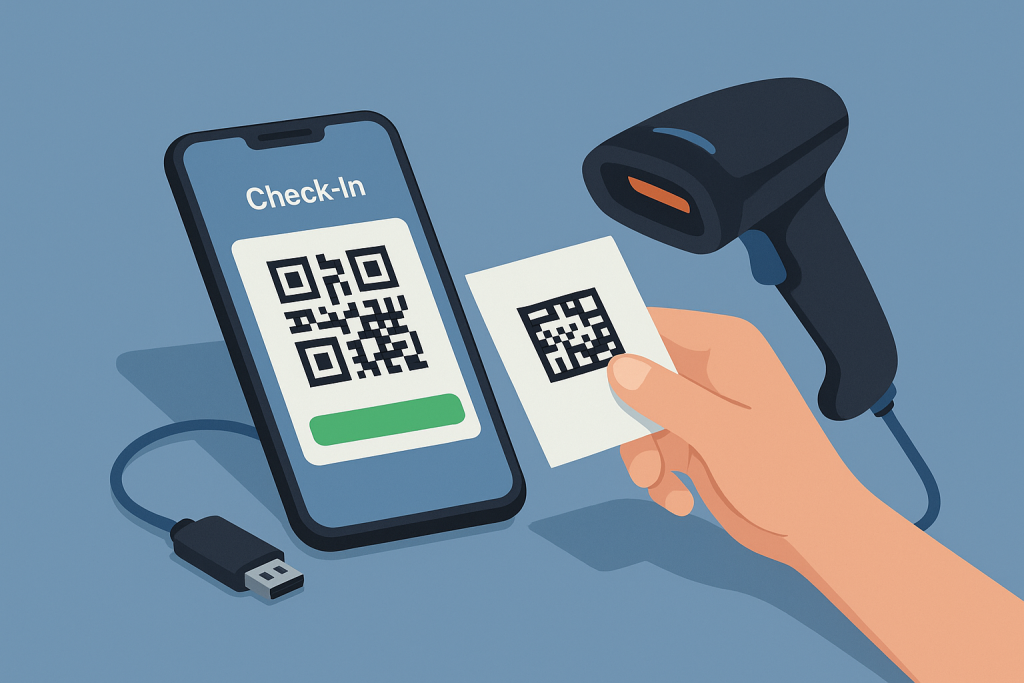
Many scanners behave like a keyboard once connected. They read the code and “type” its value into the active field. Checkinera then validates the ticket.
Do Not Ignore Keyboard Layout
Because many scanners behave like keyboards, the keyboard layout on the connected device can matter. If the layout is wrong, the scanned value may appear strange, incomplete, or different from what the ticket code actually contains.
Before event day, test the scanner on the exact device you plan to use. Scan a few real sample tickets and confirm that Checkinera reads them correctly.
Can You Use Multiple Scanners on One Device?
Technically, some computers or mobile devices may allow more than one scanner to connect. In practice, that is not the workflow you want.
Since scanners act like keyboards, multiple scanners on one device behave like multiple people typing into the same field at the same time. That can create confusion and scanning mistakes.
Best practice: use one scanner per device, then add more devices if you need more check-in capacity.
Can You Use a Generic QR or Barcode App?
Generic scanning apps can read a code, but that is not enough for event check-in.
A Tickera ticket is not just a printed value. Behind it is live data on your website: ticket status, attendee details, available check-ins, and whether the ticket has already been used.
Checkinera connects to your website using the event URL and an event-specific API key. That is why it can validate the ticket instead of merely reading the code.
| Generic scanner app | Checkinera |
| Reads the visible code | Reads and validates the ticket |
| Does not know ticket status | Checks live ticket data |
| Cannot mark attendees as checked in | Updates check-in status |
| No event-specific logic | Works with Tickera event settings |
Recommended Setup by Event Size
| Event type | Suggested setup |
| Small workshop or class | Checkinera app camera on one phone or tablet |
| Mid-size venue event | Two or more Checkinera devices, tested in venue lighting |
| Dark venue or nightclub | Checkinera with dedicated barcode/2D scanners |
| Large festival or conference | Multiple check-in points, one scanner per device, clear staff workflow |
Final Thoughts
There is no universal answer to “app or scanner?” The right choice depends on your venue, lighting, crowd size, staff, and how quickly attendees arrive.
For many events, the Checkinera app camera is simple and effective. For higher-pressure entrances, dedicated scanners can remove focus delays and keep the line moving. The safest approach is to test your real setup before the doors open.
Recommended Reading
- Ticket Check-In at the Door: How to Keep Event Entry Fast and Stress-Free
- How to Maximize the Efficiency of Checkinera
- The Anatomy of a Perfect Ticket
FAQ
Should I use a barcode scanner or a check-in app for events?
It depends on your event size and setup. Dedicated barcode scanners suit very high-volume, fixed entrances, while a check-in app on phones or tablets is flexible, portable, and quick to deploy. Many events use a mix of both.
Are phone check-in apps as fast as hardware scanners?
For most events, yes. Modern check-in apps scan QR codes and barcodes through the camera quickly enough to keep lines moving. Dedicated hardware can be faster and more durable for very high-throughput gates.
Can I check tickets in offline?
With the right app, yes. An offline-capable check-in app lets you validate tickets without a connection and sync records later, which is essential at venues with weak Wi-Fi.